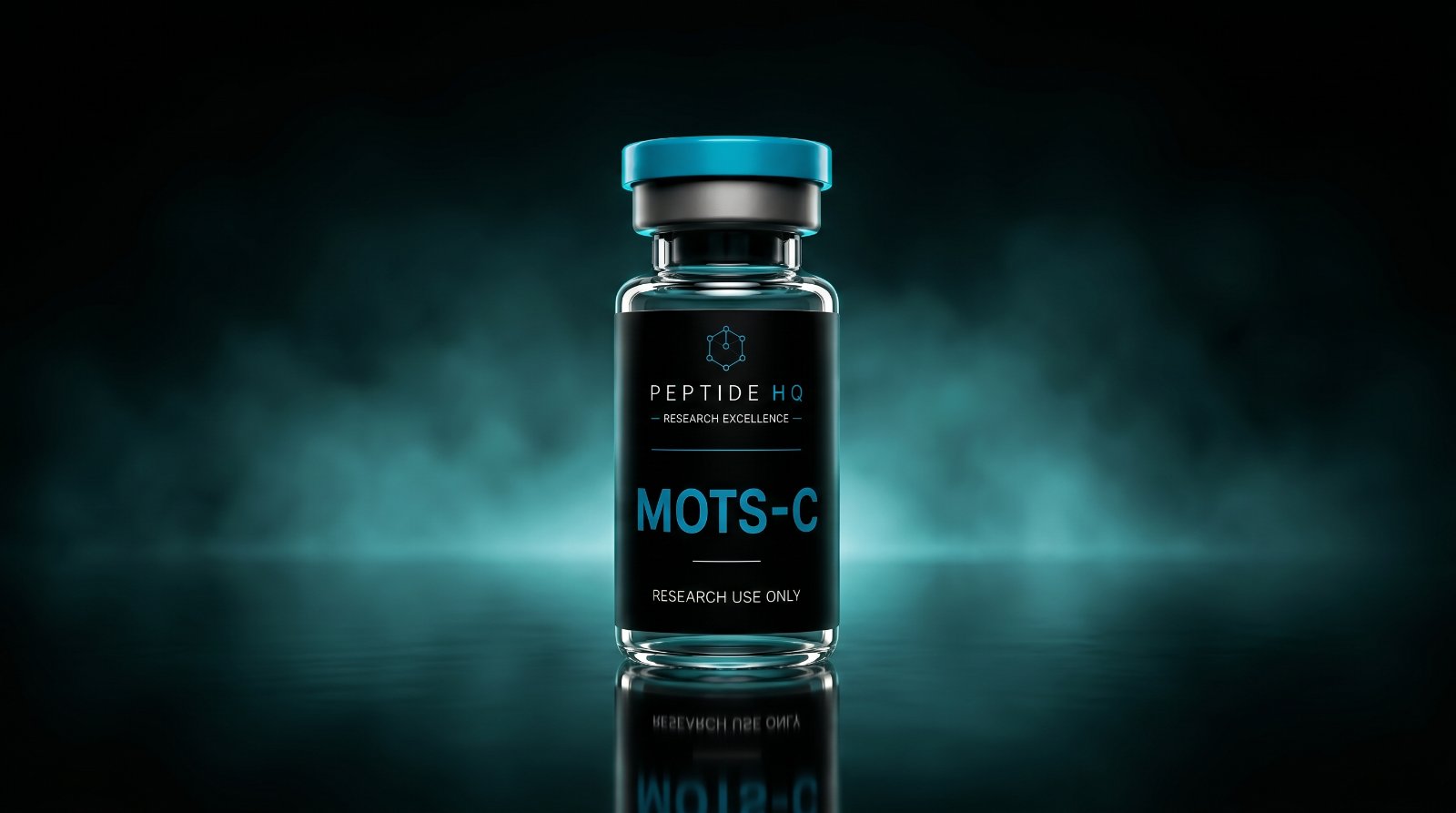
MOTS-C occupies an unusual place in peptide research: it isn't encoded in the nuclear genome like most peptides, but in the DNA of the mitochondria themselves. That origin story is a large part of why it has become a fixture of metabolism and ageing-related laboratory research. This overview covers what the molecule is, the areas science has explored, the honest state of the evidence, and the practical points for researchers sourcing it.
Important: MOTS-C discussed here is supplied strictly for laboratory and scientific research use only. It is not for human consumption, and nothing in this article is medical or usage advice.
What is MOTS-C?
MOTS-C (mitochondrial open reading frame of the twelve S rRNA type-c) is a 16-amino-acid peptide encoded within mitochondrial DNA — specifically within the 12S ribosomal RNA region. It belongs to a small, relatively recently characterised class of molecules known as mitochondrial-derived peptides (MDPs): short peptides produced from the mitochondrial genome rather than the nuclear genome.
That distinction matters scientifically. Mitochondria were long viewed mainly as the cell's power plants; the discovery that their DNA encodes signalling peptides like MOTS-C reframed them as active participants in cellular communication — and made the MDP class an active frontier of research.
Key characteristics from the literature:
- A 16-amino-acid peptide (~2.2 kDa)
- Encoded in the mitochondrial 12S rRNA region — one of the defining mitochondrial-derived peptides
- First characterised in the peer-reviewed literature in the mid-2010s, making it a comparatively young research compound
- Typically supplied for research as a lyophilised (freeze-dried) powder
What Has the Research Explored?
MOTS-C research is younger and smaller in volume than the literature on long-studied peptides like GHK-Cu or BPC-157, but it spans several active themes:
Cellular metabolism. The foundational MOTS-C work examined its role in metabolic signalling in cellular and animal models — including research involving the AMPK pathway, a central regulator of cellular energy balance, and studies of glucose handling and insulin sensitivity in laboratory models.
Exercise physiology models. A notable strand of research has examined MOTS-C in the context of exercise — including studies measuring its levels in response to exercise in experimental settings, and investigations into whether it behaves as an "exercise-induced" mitochondrial signal.
Ageing and longevity research. As a mitochondrial-derived peptide, MOTS-C features in the broader research conversation around mitochondrial function and ageing — including studies of its levels across age in experimental models and its behaviour in ageing-related laboratory systems.
Cellular stress response. Laboratory work has also examined how MOTS-C behaves under metabolic stress, including research showing it can translocate to the cell nucleus under certain stress conditions in vitro — an unusual property for a mitochondrially encoded peptide and a subject of ongoing study.
The Honest State of the Evidence
As with most research peptides, candour matters: the MOTS-C evidence base is predominantly preclinical — cell-culture and animal-model work, with limited early human research. It is a young molecule in research terms; the first major characterisation papers date only to the mid-2010s, and the field is still mapping its basic biology. That makes it a genuinely interesting research compound — there are open questions everywhere — but it also means confident claims about MOTS-C should be treated with scepticism wherever you encounter them. It is studied because much remains unknown, which is precisely what makes it a research chemical rather than anything more.
What Researchers Should Check When Sourcing MOTS-C
The quality fundamentals are the same as for any research peptide — covered in depth in our guide to choosing a UK research peptide supplier and our guide to reading a Certificate of Analysis:
- Batch-specific Certificate of Analysis — identity and purity documented for the batch actually supplied
- Independent third-party testing — purity by HPLC, identity confirmed by mass spectrometry
- Correct form and storage — lyophilised powder, stored under temperature-controlled conditions
- A verifiable, registered company — transparent, research-use-only practices and no medical claims
MOTS-C at Peptide HQ
Peptide HQ supplies MOTS-C for laboratory research use only. Batch Certificates of Analysis are published on our site, with purity independently verified by a third-party laboratory using HPLC and mass spectrometry, and all peptides stored under temperature-controlled conditions.
You can find MOTS-C alongside related research compounds in our Longevity and Mitochondrial research category.
All products are for laboratory research use only and are not for human consumption.