
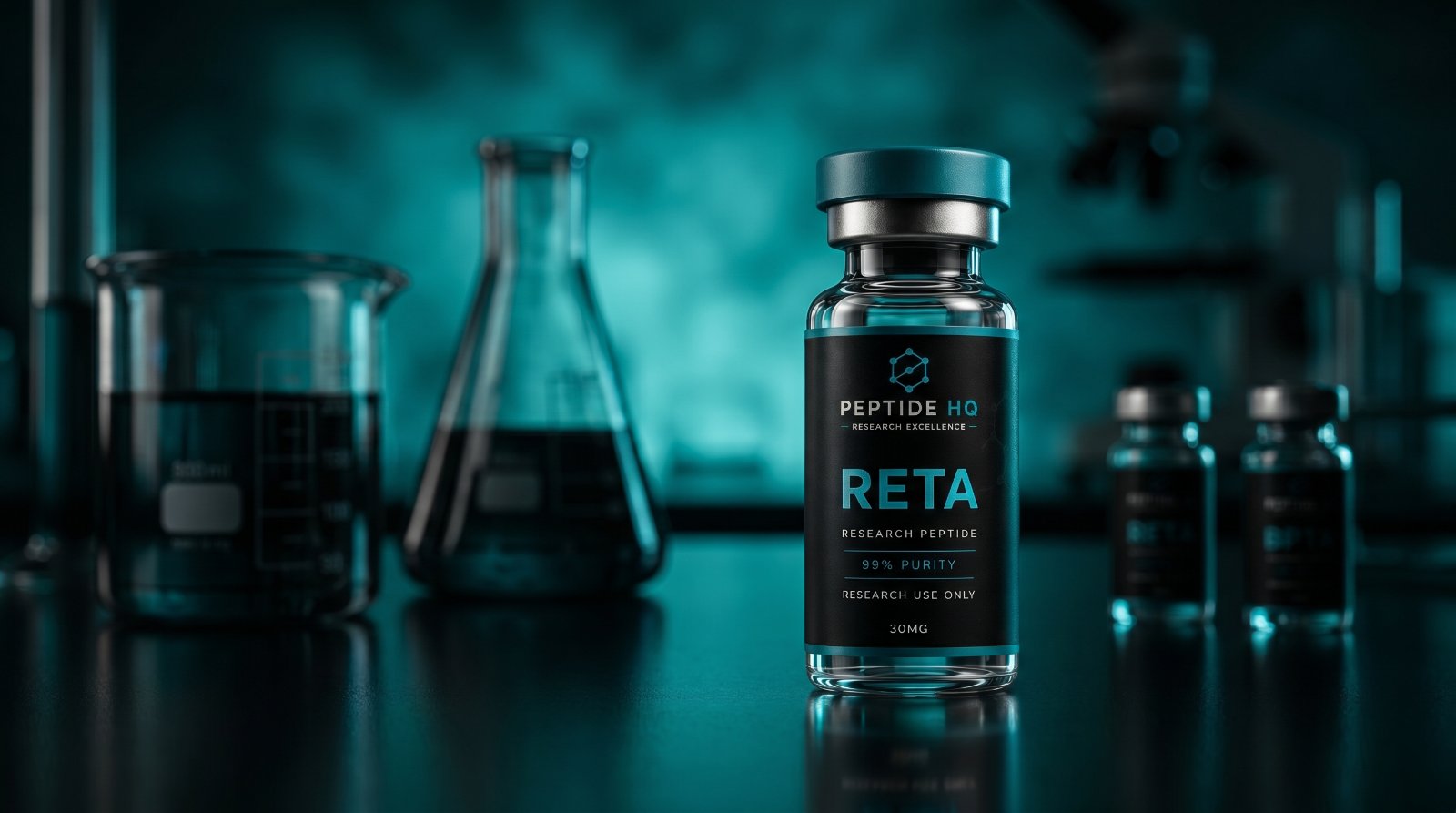
Few research compounds attract as much attention — or as much misinformation — as retatrutide. It sits at the centre of the most active area of pharmaceutical research in the world right now, which makes accurate, sober information about it both scarce and necessary. This overview covers what the molecule actually is, the research and clinical-development context around it, and the points researchers should understand clearly before sourcing it.
Important: Retatrutide discussed here is supplied strictly for laboratory and scientific research use only. It is not for human consumption. It is an unapproved, investigational compound, and nothing in this article is medical or usage advice.
What is Retatrutide?
Retatrutide is an investigational triple hormone receptor agonist — a single peptide-based molecule engineered to activate three receptors involved in metabolic signalling:
- GIP (glucose-dependent insulinotropic polypeptide) receptor
- GLP-1 (glucagon-like peptide-1) receptor
- Glucagon receptor
This "triple agonist" design is what makes it scientifically notable. Earlier molecules in this field targeted one receptor (GLP-1 agonists) or two (GIP/GLP-1 dual agonists); retatrutide belongs to the next generation engineering all three into a single molecule. It is often referred to in research communities by the shorthand "Reta."
The compound was developed by Eli Lilly and is, at the time of writing, in late-stage (Phase 3) clinical development. That status matters and is worth stating precisely: retatrutide is an investigational drug candidate. It is not an approved medicine anywhere in the world.
Why Is It So Heavily Researched?
Incretin and multi-receptor agonist biology is currently the most intensively studied territory in metabolic science. Within that field, retatrutide is being evaluated in a large clinical-trial programme spanning multiple research areas — including obesity and overweight, type 2 diabetes, and a range of weight-related conditions under active investigation.
Unusually for a compound discussed in research-peptide circles, retatrutide has a substantial and growing clinical literature: peer-reviewed Phase 2 results have been published in major medical journals, and Phase 3 trial results have begun to be announced, with more expected. We deliberately do not summarise trial outcomes here — outcome data belongs in its proper context, and we would encourage anyone interested to read the primary sources: the published papers and the trial registry entries are publicly available and searchable (the trial programme is registered on ClinicalTrials.gov, and results are published in the peer-reviewed medical literature).
The Distinction That Matters Most
This is the section to read slowly, because it is where confusion — and bad actors — thrive:
Research-grade retatrutide is not the pharmaceutical product, and has no connection to it. The clinical trials are conducted by a pharmaceutical company using its own manufactured drug product, under medical supervision, within regulated trials. Research-chemical supply is an entirely separate thing: synthesised reference material, supplied to the research community for laboratory work, with no involvement in — and no equivalence to — any clinical programme.
Because retatrutide is unapproved, there is no legitimate route by which it can be sold for human use anywhere. Any supplier marketing it with health outcomes, transformation promises, or anything resembling patient benefit is not describing their product honestly — they are advertising an unlicensed medicine, and that tells you everything about how seriously they take compliance in general. The compound's popularity has also attracted exactly the quality problems you would expect: high demand, grey-market supply, and material of unknown identity and purity circulating widely. For researchers, that makes sourcing discipline more important for this compound than perhaps any other.
Regulatory Context
- Retatrutide is an investigational compound in clinical development. It is not licensed as a medicine in the UK, US, or anywhere else.
- In the UK it may be lawfully supplied only as a research chemical, for laboratory use — never for human consumption, and never with medicinal claims.
- Regulators in multiple jurisdictions have warned about grey-market products in this category, and the class has been a focus of counterfeit and substandard-product concern. This is a compound where documentation is not a nicety — it is the entire basis for trusting what is in the vial.
What Researchers Should Check When Sourcing Retatrutide
Everything in our guide to choosing a UK research peptide supplier applies with extra force here:
- Batch-specific Certificate of Analysis — non-negotiable for a compound this widely counterfeited; see our guide to reading a COA
- Independent third-party testing — purity by HPLC, identity confirmed by mass spectrometry; for retatrutide, identity confirmation is the critical check
- Correct form and storage — lyophilised powder, temperature-controlled storage
- A supplier that does not make health claims — with this compound especially, outcome-marketing is the clearest red flag a supplier can wave
Retatrutide at Peptide HQ
Peptide HQ supplies retatrutide for laboratory research use only. Batch Certificates of Analysis are published on our site, with purity independently verified by a third-party laboratory using HPLC and mass spectrometry, and all peptides stored under temperature-controlled conditions. We make no claims about this compound beyond what it is — that is the point.
You can find retatrutide alongside related research compounds in our GLP-1 Peptides research category.
All products are for laboratory research use only and are not for human consumption.